Tuesday, April 14, 2015

Painting Water

One of the things I like about oil paint is that it doesn't dry instantly. When painting water, the slow drying time enables me to blend the edges. I can "push and pull" the paint around my board until the image feels wet. If it looks static in a section, I can go back in and move it around some more.

On the other hand, if the painting starts to look mushy, I can redefine some edges and still keep them soft as they blend into the surrounding paint.

If I have a limited time to paint I generally do not start a large section of water. Hours and hours of uninterrupted painting works best as I think through my water passages.


From the last post, I have brightened the sand reflections in the oncoming wave. The next closer section is also more defined and brighter.
A tricky area is the middle wave. I started with raw umber, some yellow ochre, and naples yellow and titanium white. As is usually the case when I am unsure of the color, my first go around was too light. Adding more raw sienna and a little van dyke brown added more depth. Sometimes I wait to add highlights until the section is done. Here, I found it helpful to put in the highlights as I painted. They gave structure to the wave.
For the closest water section I used cerulean blue with some hints of manganese blue. These warm blues helped bring this section of water closer.
The foam. I started with the dark forward color, then added the lightest top section. Mixing a middle tone, I painted it in-between the two. Seems to work.

Friday, April 10, 2015

Variety + Experimentation = Risk

Variety + Experimentation = Risk

Being an artist is a risk. Not only financially but most artists put their whole heart into their work which is then evaluated by others to determine whether it is worthy of purchase. This is not a profession for the faint of heart.

In such a risky venture, wouldn't it make sense to reduce the risk? No artist wants a piece to "fail" and not sell. Therefore, if you paint a beach scene with sand dunes and flowing grasses and it sells, shouldn't you be back at the easel and paint another beach? Maybe another 7 beaches? How about in 5 different sizes and you could vary the frame color.

However tempting that would be, I would say no. In each piece I am attempting to tell a new story. If I told a unique beach story, would the next beach scene have a story just as fresh? As I am working out the concept for a new painting I ask myself two questions:
Is this a new story for me to tell?
Am I telling the story in a fresh way that I haven't seen before?

Hence there is a lot of variety in my work. I am mostly a wildlife artist because it is easy for me to get excited about my subjects. But, whether it is a violinist in Genoa, outlaws of the Old West, or a sailboat on a summer day, I have other stories I want to tell.  Variety - the spice of life.

Okay. So I have a variety of genre in my work. Wouldn't it make sense to approach each piece the same way? Limit the experimentation to reduce the risk.
I firmly believe that one's artistic growth is tied to experimentation. I could paint different subjects all day long and my growth as an artist would be slower than if I tried some new techniques.

I've tried large paintings almost solely painted by glazing; metallic gold gesso base; Venetian red gesso; gray-toned gessoboard, tight detail, impressionistic interpretations, broad landscapes, and portraits with no discernible background.

For this painting, I am trying a soft look and using a tan/brown-toned gessoboard. There isn't as much a learning curve for my palette as there was with the Venetian red gesso  - or maybe I am used to adjusting my palette on the fly.


Variety + Experimentation = Risk

Being an artist is a risk. I believe playing it safe in my art is too great a risk. It may seem that painting a slight variation of a successful piece would give one the best chance of selling. Maybe....for a while. But it is a limiting experience for both the artist and the collector.

The greatest opportunity for growth is rooted in both variety and experimentation. New subjects, new ideas paired with different approaches. That may seem like a risk but I believe it is the best way to become the best artist I can be.


Wednesday, April 1, 2015

Final Stage

The Violinist
24" X 20"
Original Oil

I should have taken photos while I was working on the violin and violinist but I was having too much fun. One night I wrapped up after 3:30am, another morning I was at the easel before 7am. 

The best part is that I had a chance to paint with fellow artist Lee Kromschroeder. He has been a friend for years and had a show in town. During the week he stayed at our house, he worked on an extra piece for the show at Pacific Flyway Gallery while I worked on this painting. Lee's insight and suggestions made this a better painting. Thanks Lee!
One main suggestion was to take down the brilliance of the yellow building behind the central figure. It was such a pretty color but once I decided on keeping the whitish hat, the yellow needed to be more subdued.

This subject matter was a departure for me. I've never painted an instrument before. But, in some ways, this piece fits right in with my other work. In my wildlife paintings I try to create a story, a sense of place. And if the emotion I felt when I was there comes through, even better. 
I wanted to tell this story on the centuries-old streets of Genoa -  and wait for the first notes to play.

Saturday, March 28, 2015

Detail

When working on a painting like this, I often think about detail. How much detail goes into the section I am working on? You want enough detail to tell the story but not so much that it pulls focus from the main theme. The difference between the two is a very fine line.


If I had painted every outside line of the cobblestones into the background, you would not as readily notice the open violin case. If the people in the distance had sharp edges and lots of detail, your eyes would be drawn to them and linger there.

By the way, I had a blast painting the violin case. Those purple-y velvet colors are uncommon for my normal wildlife palette.

Tuesday, March 24, 2015

The Title Character

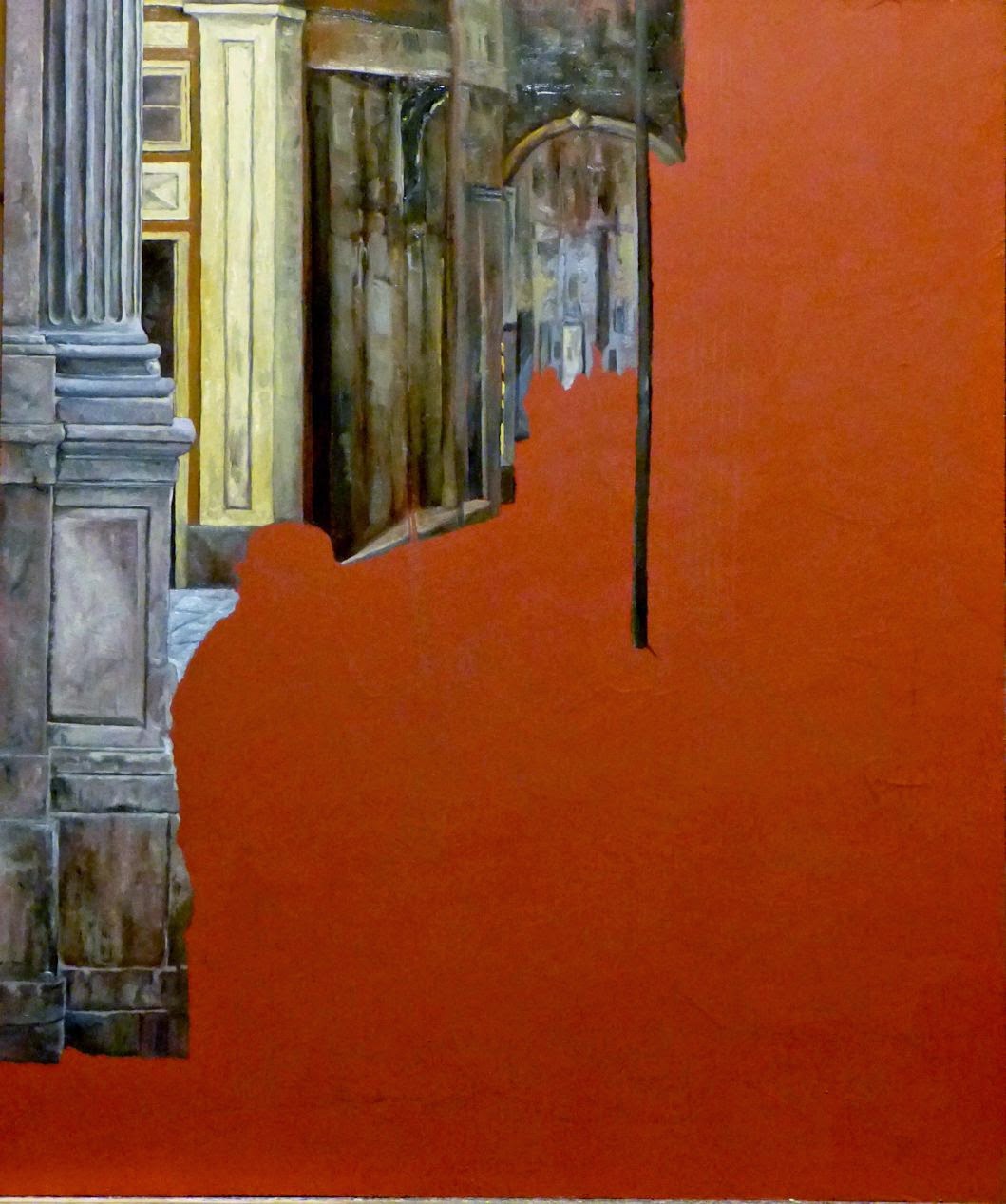
All of the previous work has been setting the stage for the title character. You can catch a glimpse of him now.


Saturday, March 21, 2015

More of the story

I've played around with the right side for quite a while. Adding colors, removing colors. Playing with the arch. One of the fascinating things about Genoa is how the movers and shakers of the town kept trying to outdo each other so they, not their neighbor, could welcome distinguished dignitaries with their grand home.
We'd be walking down a street and see an alcove and inside was a grand foyer with elaborate murals on all the walls and on the ceiling. This would lead into a courtyard complete with fountains and life size marble sculptures and then into the private home. Until you got to the private entrance to the home, all was open for anyone to view. If we hadn't walked the streets, we would have missed the amazing art and architecture. We'd walk back and forth across the small streets just to see what impressive display was next.


Thursday, March 19, 2015

A little Imagination


If one just paints exactly what one sees, are you telling the whole story? I've been wanting to paint this since Oct of 2013. My memory of the scene was different than my reference photos. 
One of the problems with a camera is that it has no soul and no opinion. Each and every element has equal weight and no personality.

This scene has been playing out in my mind for a couple years. It was definitely a story which really touched me. Now, how do I recreate the feeling I had?
First, I threw away the literal look of the buildings. I liked the column but the yellow building in the back left is from a different part of Genoa. The building that is there was covered in brown paper for its remodel. That splash of yellow color fit what I was going for.  I saw arches and lots of beautiful architecture in this picturesque Italian town so why not take some elements and incorporate them into the story.

Will this be a true representation of Genoa? Hmmm. You would not be able to walk down a particular street and see this array of buildings. (though I did not walk every street.) Would I recognize the feeling I had of Genoa in this piece? Yes. In that way it is true to how I remember Genoa.

While Genoa is the place where I read the first page, the story could be in a number of places.

Stay tuned for the next page.